World fitness federation | World body building federation


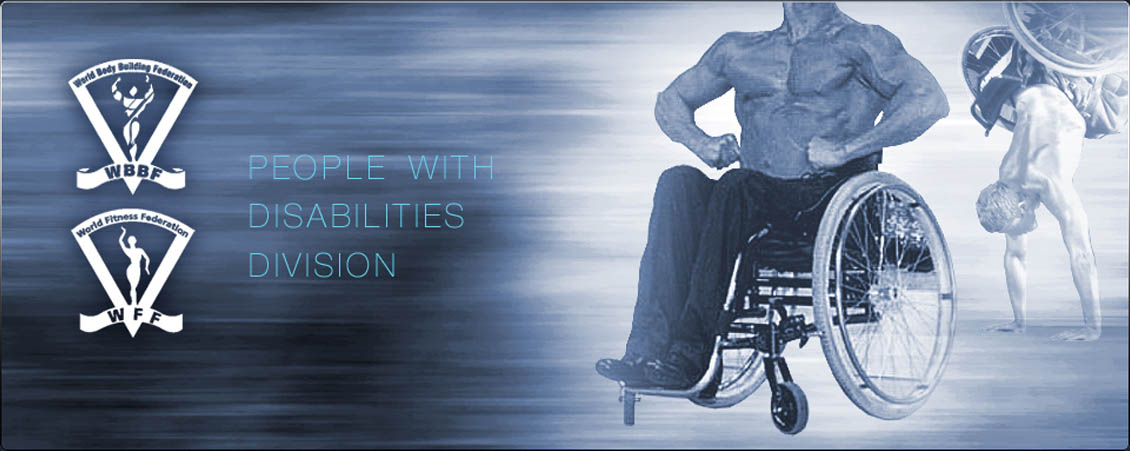


DISABLED SPORT
World Bodybuilding History.
WFF-WBBF PROFESSIONAL DIVISION FOR ATHLETES WITH DISABILITIES.
From the 1998 Palanga Congress to the International Professional Stage
The WFF-WBBF International Congress held in Palanga in 1998 became an important milestone in the history of sport for people with disabilities. Following the decisions adopted at the Congress, the World WFF-WBBF Federation (World Fitness Federation, World Body Building Federation) began systematically developing activities involving athletes with disabilities. According to the federation's historical sources, continuous work with athletes with disabilities began in 1999.
This was an important step from individual athlete appearances toward a consistent international competition system for athletes with disabilities, in which athletes could compete for World and European Championship titles and participate in international tournaments.
The First Generation of Champions
The first international WFF-WBBF champions among athletes with disabilities were Garib Jounis (Netherlands), Torsten Petersen (Denmark), Aleksandr Koroliov (Estonia), and Sergej Beglik (Lithuania).
A special place in this history belongs to Lithuanian athlete Sergej Beglik (Lithuania). The federation's historical sources emphasize that he won all the official international competitions that were possible at the time — the World and European Championships, as well as the international “Universe” tournament. Then his trainer was the best Lithuania bodybuilder of all times Natalija Murnikoviene.
The official WFF-WBBF historical list of champions shows that Torsten Petersen (Denmark) became World Champion in 1999, 2000 and 2002, Aleksandr Koroliov (Estonia) in 2001, Sergej Beglik (Lithuania) in 2003, and Garib Younis (Netherlands) in 2004.
This first generation of athletes laid the foundations for the international WFF-WBBF tradition in sport for people with disabilities.
An International Sports Movement
In subsequent years, numerous high-level international athletes from different countries emerged in the WFF-WBBF division for athletes with disabilities.
Among them were:
Mickael Louvel (France), Peter Smit (South Africa), Tolga Murat Balikci (Turkey), Dian Michailov (Bulgaria), Petar Milenkovič (Serbia), Anastasia Belkovskaja (Russia), Gustavo Rodrigues (Brazil), Karol Milewski (Poland), Mariusz Krzystof Kupczak (Poland), Grzegorz Dabrowski (Poland), Aleksandr Golub (Ukraine), Nias Izmailov (Ukraine), Oleg Abornev (Ukraine), Oleg Pileckij (Ukraine), Aleksandr Rossomakin (Ukraine), Ravinder Singh (India), Anand Arnold (India), and Aleksejs Petkevics (Latvia).
Lithuania was represented by Viktoras Topolis (Lithuania), Nikolajus Mironovas (Lithuania), Arturas Krutulis (Lithuania), Genadijus Zametaškinas (Lithuania), Karolis Stončius (Lithuania), and Artūras Bolyčevas (Lithuania).
This list of athletes demonstrates the true international character of the division: it represents countries from Europe, Asia, Africa, and South America.
The World Champions’ Chain
The historical list of World Champions published by WFF-WBBF shows a consistent succession of champions from different countries. Following the first generation, the World Champions were:
- Oleg Abornev (Ukraine) — 2014;
- Karol Milewski (Poland) — 2015;
- Anand Arnold (India) — 2016;
- Mariusz Krzystof Kupczak (Poland) — 2017 and 2019;
- Tolga Murat Balikci (Turkey) — 2018;
- Aleksejs Petkevics (Latvia) — 2020, 2021 and 2022;
- Grzegorz Piotr Dabrowski (Poland) — 2023.
This succession of champions clearly demonstrates how the geographical distribution of leading athletes in disability sport changed over more than two decades — from athletes representing Lithuania, Denmark, Estonia and the Netherlands to champions from Ukraine, Poland, India, Turkey and Latvia.
The Professional Division — A New Historical Stage
Another essential step for WFF-WBBF was the creation of a professional division for athletes with disabilities.
The Executive Council of the federation decided to establish the WFF-WBBF Professional Division for Athletes with Disabilities.
It consists of two main categories:
- general category for professional athletes with disabilities;
- category for professional athletes with disabilities competing in wheelchairs.
Athletes who meet the WFF-WBBF professional requirements may receive a WFF-WBBF Professional Card (“Pro Card”) and participate in professional competitions.
This represented a qualitatively new stage. An athlete with a disability became not only a participant in international amateur competitions, but also an athlete within the professional sports system.
In 2018, Tolga Murat Balikci (Turkey) became the first-ever WFF-WBBF World Professional Champion among athletes with disabilities. In the same year, he also won the World Amateur Championship among all participating athletes.
Professional Champions
Among the most prominent WFF-WBBF professional athletes in disability sport were:
- Anand Arnold (India);
- Aleksejs Petkevics (Latvia);
- Tolga Murat Balikci (Turkey);
- Mickael Louvel (France);
- Kamil Kowalczyk (Poland).
The international character of the professional division continued in later years.
14 Countries — One Sporting History
The historical list of WFF-WBBF athletes in disability sport represents 14 countries:
the Netherlands, Denmark, Estonia, Lithuania, South Africa, Turkey, Bulgaria, Russia, Ukraine, Brazil, Poland, France, India, and Latvia.
This is not merely a statistical fact. The geography of 14 countries demonstrates that the WFF-WBBF disability sport division has grown into an international sports system, bringing together representatives of different continents and sporting schools.
A special place in this history belongs to Lithuania. It was not only the home country of one of the first champions — Sergej Beglik (Lithuania) — but also one of the countries from which several high-level international athletes emerged. Furthermore, the international congress held in Palanga in 1998 is identified in the federation's history as an important starting point for further work with athletes with disabilities.
Conclusion
The history of WFF-WBBF disability sport is not merely a history of World Champions, medals and titles.
It is a journey of more than two decades — from the decisions of the 1998 Palanga Congress to an international professional sports system in which athletes from 14 countries competed for World Championship titles and professional status.
During this period, several generations of athletes emerged. Among them were Torsten Petersen (Denmark), Garib Jounis (Netherlands), Aleksandr Koroliov (Estonia), Sergej Beglik (Lithuania), Oleg Abornev (Ukraine), Karol Milewski (Poland), Anand Arnold (India), Tolga Murat Balikci (Turkey), Mariusz Krzystof Kupczak (Poland), Aleksejs Petkevics (Latvia), Grzegorz Piotr Dabrowski (Poland) and many other athletes who became part of WFF-WBBF disability sport history.
The most important message of this history is that disability is not an obstacle to achieving the highest level of sporting excellence. An athlete with a disability can be a World Champion, a professional, a representative of their country, and an equal member of the international sporting community.
Therefore, the history of the WFF-WBBF disability sport division can be viewed as a long-term project of sporting excellence, internationalism, professionalism and inclusion.
Its origins are linked to Lithuania, while its achievements belong to the entire international sporting community.
The History of Champions — More Than a List of Titles
WFF-WBBF historical data records a consistent succession of World Champions among athletes with disabilities. It includes athletes from different generations: from Torsten Petersen, Garib Jounis and Sergej Beglik to Tolga Murat Balikci, Karol Milewski, Mariusz Krzystof Kupczak, Anand Arnold, Aleksejs Petkevics and Grzegorz Dabrowski.
Several athletes stand out particularly. In 2018, Tolga Murat Balikci became the first-ever WFF-WBBF World Professional Champion among athletes with disabilities. Aleksejs Petkevics subsequently emerged as one of the most prominent athletes with disabilities in the world, while Mariusz Krzystof Kupczak won the World Championship title more than once.
The Professional Division — A New Historical Stage
Another important step was the creation of the WFF-WBBF Professional Division for athletes with disabilities. By decision of the federation's Executive Council, a professional system was established, providing top-level athletes with the opportunity to move from amateur to professional sport.
The professional division includes two main categories:
- general category for professional athletes with disabilities;
- category for professional athletes with disabilities competing in wheelchairs.
Athletes who meet the WFF-WBBF professional criteria may receive a WFF-WBBF Professional Card (“Pro Card”) and participate in professional competitions.
This was a fundamental change: an athlete with a disability became not only a competition participant, but also a part of the professional sports system.
Professional Champions
Among the most prominent WFF-WBBF professional athletes in disability sport are:
- Anand Arnold (India);
- Aleksejs Petkevics (Latvia);
- Tolga Murat Balikci (Turkey);
- Mickael Louvel (France);
- Kamil Kowalczyk (Poland).
The professional division remains part of the WFF-WBBF competition system today. In more recent competition data published by the federation, the “Disabled Bodybuilding” category is listed among the professional categories.
The Main Conclusion of WFF-WBBF Disability Sport History
The history of WFF-WBBF disability sport is more than the history of individual champions and medals.
From the decisions adopted in Palanga in 1998 to the creation of the professional division, a journey was made from individual international appearances to an organized and international sports system.
During this period, several generations of champions emerged, while athletes from Lithuania, Europe, Asia, Africa and South America demonstrated that disability is not an obstacle to achieving the highest sporting results, becoming a World Champion, or attaining professional status.
The most important message of this history is that an athlete with a disability is not an exception here. They are an athlete striving for the highest level of sporting excellence, with the right to international recognition, professional status, and a place on the world sporting stage.
Therefore, the history of the WFF-WBBF disability sport division can be regarded as a long-term project of inclusion, sporting professionalism and international competition, whose origins are associated with Lithuania and, in particular, with the 1998 international congress in Palanga